

If you’re coming from the U.S. or Canada, property taxes are usually a significant part of owning real estate. They can be high, strictly enforced, and missing payments can quickly escalate into serious consequences (including liens or even foreclosure).
So naturally, one of the first questions buyers ask in Mexico is: How much are property taxes, and what happens if I don’t pay them?
The answer is simpler than most expect. But the context matters.
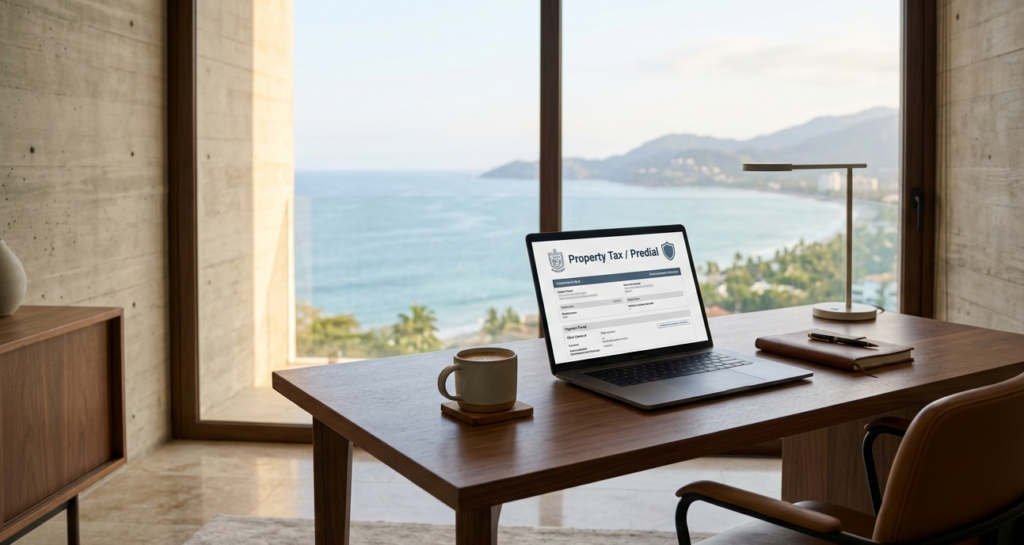
First, the cost: much lower than you’re used to
Property taxes in Mexico, known as predial, are generally very low compared to the U.S. or Canada. In many cases, they represent a small fraction of what foreign buyers are used to paying annually.
The exact amount depends on:
- The cadastral value of the property (not necessarily market value)
- The municipality
- The type of property
And something important to understand:
The assessed value used for tax purposes is often significantly lower than the actual market value.
That alone explains why the annual tax tends to feel minimal.
How it’s paid (and why many people pay early)
Property tax is paid annually to the municipality. In many areas, including Puerto Vallarta, there are incentives for early payment, typically offering small discounts if paid in the first months of the year.
Because the amounts are relatively low, most owners simply pay it once a year and move on. It’s not a heavy financial burden in the way it can be in other countries.
What the law says vs. what happens in practice
Legally, unpaid property taxes can lead to consequences. Yes, on paper, the municipality has the right to:
- Place liens on the property
- Initiate collection procedures
- And eventually pursue legal action
But here’s where context becomes important. In practice, this is not an immediate or straightforward process.
Unlike in the U.S., where tax enforcement systems are highly structured and time-driven, in Mexico:
- Collection processes can be slow
- Enforcement is not always aggressive
- And escalation takes time
That does not mean there are no consequences. It means the timeline and process are very different
What actually happens if you don’t pay
In most real scenarios, what you’ll see first is:
- Accumulated unpaid taxes
- Penalties and surcharges
- Administrative complications
The issue usually surfaces when:
- You try to sell the property
- You need to regularize documentation
- Or you begin any formal transaction
At that point, all outstanding taxes must be paid in order to proceed. So while you may not see immediate action, the obligation doesn’t disappear—it simply carries forward.

Why this gets misunderstood
Many foreign buyers interpret this in one of two extremes:
- Either they assume it works exactly like back home (strict and immediate enforcement)
- Or they assume it doesn’t matter at all because “nothing happens”
Neither is accurate. The reality sits in the middle: There are legal consequences, but they are typically slower, less predictable, and more tied to administrative processes than immediate enforcement.
So, no, you are not going to lose your property if you don’t pay. But unpaid taxes will eventually affect your ability to use, sell, or formalize your property.
Should this be a concern?
From an investment standpoint, property taxes in Mexico are not a pressure point. They’re low, predictable, and easy to manage.
The risk is not the cost.
Where I come in
This is one of those areas where expectations from other markets don’t translate directly. And while it’s not a complicated topic, misunderstanding it can lead to unnecessary confusion later on.
My role is to help you understand how things actually work here, so you can make decisions with clarity, not assumptions. Because in this market, it’s not just about knowing the rules… It’s about understanding how they’re applied in real life.



Leave a Comment —